WE HAVE suffered two heavy
losses at once which merge into one enormous bereavement. There have
been struck down from our ranks two leaders whose names will be for ever
entered in the great book of the proletarian revolution: Karl
Liebknecht and Rosa Luxemburg. They have perished. They have been
killed. They are no longer with us!
Karl Liebknecht’s name, though already known, immediately gained
world-wide significance from the first months of the ghastly European
slaughter. It rang out like the name of revolutionary honour, like a
pledge of the victory to come. In those first weeks when German
militarism celebrated its first orgies and feted its first demonic
triumphs; in those weeks when the German forces stormed through Belgium
brushing aside the Belgian forts like cardboard houses; when the German
420mm cannon seemed to threaten to enslave and bend all Europe to
Wilhelm; in those days and weeks when official German social-democracy
headed by its Scheidemann and its Ebert bent its patriotic knee before
German militarism to which everything, at least it seemed, would
submit—both the outside world (trampled Belgium and France with its
northern part seized by the Germans) and the domestic world (not only
the German junkerdom, not only the German bourgeoisie, not only the
chauvinist middle-class but last and not least the officially recognized
party of the German working class); in those black, terrible and foul
days there broke out in Germany a rebellious voice of protest,
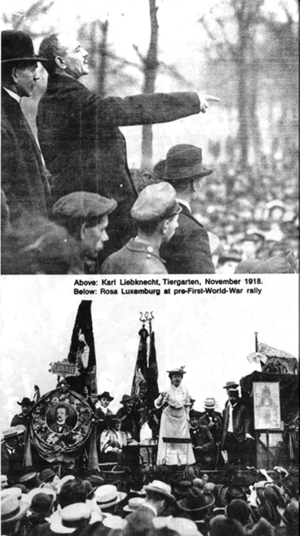
of anger and imprecation; this was the voice of Karl Liebknecht. And it resounded throughout the whole world!
In France where the mood of the broad masses then found itself under
the heel of the German onslaught; where the ruling party of French
social-patriots declared to the proletariat the necessity to fight not
for life but until death (and how else when the ‘whole people’ of
Germany is craving to seize Paris!); even in France Liebknecht’s voice
rang out warning and sobering, exploding the barricades of lies, slander
and panic. It could be sensed that Liebknecht alone reflected the
stifled masses.
In fact however even then he was not alone as there came forward hand
in hand with him from the first day of the war the courageous,
unswerving and heroic Rosa Luxemburg. The lawlessness of German
bourgeois parliamentarism did not give her the possibility of launching
her protest from the tribune of parliament as Liebknecht did and thus
she was less heard. But her part in the awakening of the best elements
of the German working class was in no way less than that of her comrade
in struggle and in death, Karl Liebknecht. These two fighters so
different in nature and yet so close, complemented each other, unbending
marched towards a common goal, met death together and enter history
side by side.
Karl Liebknecht represented the genuine and finished embodiment of an
intransigent revolutionary. In the last days and months of his life
there have been created around his name innumerable legends: senselessly
vicious ones in the bourgeois Press, heroic ones on the lips of the
working masses.
In his private life Karl Liebknecht was—alas!—already he merely was
the epitomy of goodness, simplicity and brotherhood. I first met him
more than 15 years ago. He was a charming man, attentive and
sympathetic. It could be said that an almost feminine tenderness, in the
best sense of this word, was typical of his character. And side by side
with this feminine tenderness he was distinguished by the exceptional
heart of a revolutionary will able to fight to the last drop of blood in
the name of what he considered to be right and true. His spiritual
independence appeared already in his youth when he ventured more than
once to defend his opinion against the incontestable authority of Bebel.
His work amongst the youth and his struggle against the Hohenzollern
military machine was marked by great courage. Finally he discovered his
full measure when he raised his voice against the serried warmongering
bourgeoisie and the treacherous social-democracy in the German Reichstag
where the whole atmosphere was saturated with miasmas of chauvinism. He
discovered the full measure of his personality when as a soldier he
raised the banner of open insurrection against the bourgeoisie and its
militarism on Berlin’s Potsdam Square. Liebknecht was arrested. Prison
and hard labour did not break his spirit. He waited in his cell and
predicted with certainty. Freed by the revolution in November last year,
Liebknecht at once stood at the head of the best and most determined
elements of the German working class. Spartacus found himself in the
ranks of the Spartacists and perished with their banner in his hands.
Rosa Luxemburg’s name is less well-known in other countries than it
is to us in Russia. But one can say with all certainty that she was in
no way a lesser figure than Karl Liebknecht. Short in height, frail,
sick, with a streak of nobility in her face, beautiful eyes and a
radiant mind she struck one with the bravery of her thought. She had
mastered the Marxist method like the organs of her body. One could say
that Marxism ran in her blood stream.
I have said that these two leaders, so different in nature,
complemented each other. I would like to emphasize and explain this. If
the intransigent revolutionary Liebknecht was characterized by a
feminine tenderness in his personal ways then this frail woman was
characterized by a masculine strength of thought. Ferdinand Lassalle
once spoke of the physical strength of thought, of the commanding power
of its tension when it seemingly overcomes material obstacles in its
path. That is just the impression you received talking to Rosa, reading
her articles or listening to her when she spoke from the tribune against
her enemies. And she had many enemies! I remember how, at a congress at
Jena I think, her high voice, taut like a wire, cut through the wild
protestations of opportunists from Bavaria, Baden and elsewhere. How
they hated her! And how she despised them! Small and fragilely built she
mounted the platform of the congress as the personification of the
proletarian revolution. By the force of her logic and the power of her
sarcasm she silenced her most avowed opponents. Rosa knew how to hate
the enemies of the proletariat and just because of this she knew how to
arouse their hatred for her. She had been identified by them early on.
From the first day, or rather from the first hour of the war, Rosa
Luxemburg launched a campaign against chauvinism, against patriotic
lechery, against the wavering of Kautsky and Haase and against the
centrists’ formlessness; for the revolutionary independence of the
proletariat, for internationalism and for the proletarian revolution.
Yes, they complemented one another!
By the force of the strength of her theoretical thought and her
ability to generalize Rosa Luxemburg was a whole head above not only her
opponents but also her comrades. She was a woman of genius. Her style,
tense, precise, brilliant and merciless, will remain for ever a true
mirror of her thought.
Liebknecht was not a theoretician. He was a man of direct action.
Impulsive and passionate by nature, he possessed an exceptional
political intuition, a fine awareness of the masses and of the situation
and finally an unrivalled courage of revolutionary initiative.
An analysis of the internal and international situation in which
Germany found herself after November 9, 1918, as well as a revolutionary
prognosis could and had to be expected first of all from Rosa
Luxemburg. A summons to immediate action and, at a given moment, to
armed uprising would most probably come from Liebknecht. They, these two
fighters, could not have complemented each other better.
Scarcely had Luxemburg and Liebknecht left prison when they took each
other hand in hand, this inexhaustible revolutionary man and this
intransigent revolutionary woman and set out together at the head of the
best elements of the German working class to meet the new battles and
trials of the proletarian revolution. And on the first steps along this
road a treacherous blow has on one day, struck both of them down.
To be sure reaction could not have chosen more illustrious victims.
What a sure blow! And small wonder! Reaction and revolution knew each
other well as in this case reaction was personified in the guise of the
former leaders of the former party of the working class, Scheidemann and
Ebert whose names will be for ever inscribed in the black book of
history as the shameful names of the chief organizers of this
treacherous murder.
It is true that we have received the official German report which
depicts the murder of Liebknecht and Luxemburg as a street
“misunderstanding” occasioned possibly by a watchman’s insufficient
vigilance in the face of a frenzied crowd. A judicial investigation has
been arranged to this end. But you and I know too well how reaction lays
on this sort of spontaneous outrage against revolutionary leaders; we
well remember the July days that we lived through here within the walls
of Petrograd, we remember too well how the Black Hundred bands, summoned
by Kerensky and Tsereteli to the fight against the Bolsheviks,
systematically terrorized the workers, massacred their leaders and set
upon individual workers in the streets. The name of the worker Voinov,
killed in the course of a “misunderstanding” will be remembered by the
majority of you. If we had saved Lenin at that time then it was only
because he did not fall into the hands of frenzied Black Hundred bands.
At that time there were well-meaning people amongst the Mensheviks and
the Social Revolutionaries who were disturbed by the fact that Lenin and
Zinoviev, who were accused of being German spies, did not appear in
court to refute the slander. They were blamed for this especially. But
at what court? At that court along the road to which Lenin would be
forced to “flee”, as Liebknecht was, and if Lenin was shot or stabbed,
the official report by Kerensky and Tsereteli would state that the
leader of the Bolsheviks was killed by the guard while attempting to
escape. No, after the terrible experience in Berlin we have ten times
more reason to be satisfied that Lenin did not present himself to the
phoney trial and yet more to violence without trial.
But Rosa and Karl did not go into hiding. The enemy’s hand grasped
them firmly. And this hand choked them. What a blow! What grief! And
what treachery! The best leaders of the German Communist Party are no
more—our great comrades are no longer amongst the living. And their
murderers stand under the banner of the Social-Democratic party having
the brazenness to claim their birthright from no other than Karl Marx!
“What a perversion! What a mockery!&#rdquo; Just think, comrades,
that “Marxist” German Social-Democracy, mother of the working class from
the first days of the war, which supported the unbridled German
militarism in the days of the rout of Belgium and the seizure of the
northern provinces of France; that party which betrayed the October
Revolution to German militarism during the Brest peace; that is the
party whose leaders, Scheidemann and Ebert, now organize black bands to
murder the heroes of the International, Karl Liebknecht and Rosa
Luxemburg!
What a monstrous historical perversion! Glancing back through the
ages you can find a certain parallel with the historical destiny of
Christianity. The evangelical teaching of the slaves, fishermen,
toilers, the oppressed and all those crushed to the ground by slave
society, this poor people’s doctrine which had arisen historically was
then seized upon by the monopolists of wealth, the kings, aristocrats,
archbishops, usurers, patriarchs, bankers and the Pope of Rome, and it
became a cover for their crimes. No, there is no doubt however, that
between the teaching of primitive Christianity as it emerged from the
consciousness of the plebeians and the official catholicism or
orthodoxy, there still does not exist that gulf as there is between
Marx’s teaching which is the nub of revolutionary thinking and
revolutionary will and those contemptible left-overs of bourgeois ideas
which the Scheidemanns and Eberts of all countries live by and peddle.
Through the intermediary of the leaders of social-democracy the
bourgeoisie has made an attempt to plunder the spiritual possessions of
the proletariat and to cover up its banditry with the banner of Marxism.
But it must be hoped, comrades, that this foul crime will be the last
to be charged to the Scheidemanns and the Eberts. The proletariat of
Germany has suffered a great deal at the hands of those who have been
placed at its head; but this fact will not pass without trace. The blood
of Karl Liebknecht and Rosa Luxemburg cries out. This blood will force
the pavements of Berlin and the stones of that very Potsdam Square on
which Liebknecht first raised the banner of insurrection against war and
capital to speak up. And one day sooner or later barricades will be
erected out of these stones on the streets of Berlin against the servile
grovellers and running dogs of bourgeois society, against the
Scheidemanns and the Eberts!
In Berlin the butchers have now crushed the Spartacists’ movement:
the German communists. They have killed the two finest inspirers of this
movement and today they are maybe celebrating a victory. But there is
no real victory here because there has not been yet a straight, open and
full fight; there has not yet been an uprising of the German
proletariat in the name of the conquest of political power. There has
been only a mighty reconnoitering, a deep intelligence mission into the
camp of the enemy’s dispositions. The scouting precedes the conflict but
it is still not the conflict. This thorough scouting has been necessary
for the German proletariat as it was necessary for us in the July days.
The misfortune is that two of the best commanders have fallen in the
scouting expedition. This is a cruel loss but it is not a defeat. The
battle is still ahead.
The meaning of what is happening in Germany will be better understood
if we look back at our own yesterday. You remember the course of events
and their internal logic. At the end of February, the popular masses
threw out the Tsarist throne. In the first weeks the feeling was as if
the main task had been already accomplished. New men who came forward
from the opposition parties and who had never held power here took
advantage at first of the trust or half-trust of the popular masses. But
this trust soon began to break to splinters. Petrograd found itself in
the second stage of the resolution at its head as indeed it had to be.
In July as in February it was the vanguard of the revolution which had
gone out far in front. But this vanguard which had summoned the popular
masses to open struggle against the bourgeoisie and the compromisers,
paid a heavy price for the deep reconnaissance it carried out.
In the July Days the Petrograd vanguard broke from Kerensky’s
government. This was not yet an insurrection as we carried through in
October. This was a vanguard clash whose historical meaning the broad
masses in the provinces still did not appreciate. In this collision the
workers of Petrograd revealed before the popular masses not only of
Russia but of all countries that behind Kerensky there was no
independent army, and that those forces which stood behind him were the
forces of the bourgeoisie, the white guard, the counter-revolution.
Then in July we suffered a defeat. Comrade Lenin had to go into
hiding. Some of us landed in prison. Our papers were suppressed. The
Petrograd Soviet was clamped down. The party and Soviet printshops were
wrecked, everywhere the revelry of the Black Hundreds reigned. In other
words there took place the same as what is taking place now in the
streets of Berlin. Nevertheless none of the genuine revolutionaries had
at that time any shadow of doubt that the July Days were merely the
prelude to our triumph.
A similar situation has developed in recent days in Germany too. As
Petrograd had with us, Berlin has gone out ahead of the rest of the
masses; as with us, all the enemies of the German proletariat howled:
“we cannot remain under the dictatorship of Berlin; Spartacist Berlin is
isolated; we must call a constituent assembly and move it from red
Berlin—depraved by the propaganda of Karl Liebknecht and Rosa
Luxemburg—to a healthier provincial city in Germany.” Everything that
our enemies did to us, all that malicious agitation and all that vile
slander which we heard here, all this translated into German was
fabricated and spread round Germany directed against the Berlin
proletariat and its leaders, Liebknecht and Luxemburg. To be sure the
Berlin proletariat’s intelligence mission developed more broadly and
deeply than it did with us in July, and that the victims and the losses
are more considerable there is true. But this can be explained by the
fact that the Germans were making history which we had made once
already; their bourgeoisie and military machine had absorbed our July
and October experience. And most important, class relations over there
are incomparably more defined than here; the possessing classes
incomparably more solid, more clever, more active and that means more
merciless too.
Comrades, here there passed four months between the February
revolution and the July days; the Petrograd proletariat needed a quarter
of a year in order to feel the irresistible necessity to come out on
the street and attempt to shake the columns on which Kerensky’s and
Tsereteli’s temple of state rested. After the defeat of the July days,
four months again passed during which the heavy reserve forces from the
provinces drew themselves up behind Petrograd and we were able, with the
certainty of victory, to declare a direct offensive against the
bastions of private property in October 1917.
In Germany, where the first revolution which toppled the monarchy was
played out only at the beginning of November, our July Days are already
taking place at the beginning of January. Does this not signify that
the German proletariat is living in its revolution according to a
shortened calendar? Where we needed four months it needs two. And let us
hope that this schedule will be kept up. Perhaps from the German July
Days to the German October not four months will pass as with us, but
less—possibly two months will turn out sufficient or even less. But
however event proceed, one thing alone is beyond doubt: those shots
which were sent into Karl Liebknecht’s back have resounded with a mighty
echo throughout Germany. And this echo has rung a funeral note in the
ears of the Scheidemanns and the Eberts, both in Germany and elsewhere.
So here then we have sung a requiem to Karl Liebknecht and Rosa
Luxemburg. The leaders have perished. We shall never again see them
alive. But, comrades, how many of you have at any time seen them alive? A
tiny minority. And yet during these last months and years Karl
Liebknecht and Rosa Luxemburg have lived constantly among us. At
meetings and at congresses you have elected Karl Liebknecht honorary
president. He himself has not been here—he did not manage to get to
Russia—and all the same he was present in your midst, he sat at your
table like an honoured guest, like your own kith and kin—for his name
had become more than the mere title of a particular man, it had become
for us the designation of all that is best, courageous and noble in the
working class. When any one of us has to imagine a man selflessly
devoted to the oppressed, tempered from head to foot, a man who never
lowered his banner before the enemy, we at once name Karl Liebknecht. He
has entered the consciousness and memory of the peoples as the heroism
of action. In our enemies’ frenzied camp when militarism triumphant had
trampled down and crushed everything, when everyone whose duty it was to
protest fell silent, when it seemed there was nowhere a
breathing-space, he, Karl Liebknecht, raised his fighter’s voice. He
said “You, ruling tyrants, military butchers, plunderers, you, toadying
lackies, compromisers, you trample on Belgium, you terrorize France, you
want to crush the whole world, and you think that you cannot be called
to justice, but I declare to you: we, the few, are not afraid of you, we
are declaring war on you and having aroused the masses we shall carry
through this war to the end!” Here is that valour of determination, here
is that heroism of action which makes the figure of Liebknecht
unforgettable to the world proletariat.
And at his side stands Rosa, a warrior of the world proletariat equal
to him in spirit. Their tragic death at their combat positions couples
their names with a special, eternally unbreakable link. Henceforth they
will be always named together: Karl and Rosa, Liebknecht and Luxemburg!
Do you know what the legends about saints and their eternal lives are
based upon? On the need of the people to preserve the memory of those
who stood at their head and who guided them in one way or another; on
the striving to immortalize the personality of the leaders with the halo
of sanctity. We, comrades, have no need of legends, nor do we need to
transform our heroes into saints. The reality in which we are living now
is sufficient for us, because this reality is in itself legendary. It
is awakening miraculous forces in the spirit of the masses and their
leaders, it is creating magnificent figures who tower over all humanity.
Karl Liebknecht and Rosa Luxemburg are such eternal figures. We are
aware of their presence amongst us with a striking, almost physical
immediacy. At this tragic hour we are joined in spirit with the best
workers of Germany and the whole world who have received this news with
sorrow and mourning. Here we experience the sharpness and bitterness of
the blow equally with our German brothers. We are internationalists in
our sorrow and mourning just as much as we are in all our struggles.
For us Liebknecht was not just a German leader. For us Rosa Luxemburg
was not just a Polish socialist who stood at the head of the German
workers. No, they are both kindred of the world proletariat and we are
all tied to them with an indissoluble spiritual link. Till their last
breath they belonged not to a nation but to the International!
For the information of Russian working men and women it must be said
that Liebknecht and Luxemburg stood especially close to the Russian
revolutionary proletariat and in its most difficult times at that.
Liebknecht’s flat was the headquarters of the Russian exiles in Berlin.
When we had to raise the voice of protest in the German parliament or
the German press against those services which the German rulers were
affording Russian reaction we above all turned to Karl Liebknecht and he
knocked at all the doors and on all the skulls, including the skulls of
Scheidemann and Ebert to force them to protest against the crimes of
the German government. And we constantly turned to Liebknecht when any
of our comrades needed material support. Liebknecht was tireless as the
Red Cross of the Russian revolution.
At the congress of German Social-Democrats at Jena which I have
already referred to, where I was present as a visitor, I was invited by
the presidium on Liebknecht’s intiative to speak on the resolution moved
by the same Liebknecht condemning the violence and the brutality of the
Tsarist government in Finland. With the greatest diligence Liebknecht
prepared his own speech collecting facts and figures and questioning me
in detail on the customs relations between Tsarist Russia and Finland.
But before the matter reached the platform (I was to speak after
Liebknecht) a telegram report on the assassination of Stolypin in Kiev
had been received. This telegram produced a great impression at the
congress. The first question which arose amongst the leadership was:
would it be appropriate for a Russian revolutionary to address a German
congress at the same time as some other Russian revolutionary had
carried out the assassination of the Russian Prime Minister? This
thought seized even Bebel: the old man who stood three heads above the
other Central Committee members, did not like any “needless”
complications. He at once sought me out and subjected me to questions:
“What does the assassination signify? Which party could be responsible
for it? Didn’t I think that in these conditions that by speaking I would
attract the attention of the German police?” “Are you afraid that my
speech will create certain difficulties?” I asked the old man
cautiously. “Yes”, answered Bebel, “I admit I would prefer it if you did
not speak.” “Of course,” I answered, “in that case there can be no
question of my speaking.” And on that we parted.
A minute later, Liebknecht literally came running up to me. He was
agitated beyond measure. “Is it true that they have proposed you do not
speak?” he asked me. “
Yes,” I replied, “I have just settled
this matter with Bebel.” “And you agreed?” “How could I not agree,” I
answered justifying myself, “seeing that I am not master here but a
visitor.” “This is an outrageous act by our presidium, disgusting, an
unheard-of scandal, miserable cowardice!” etc., etc. Liebknecht gave
vent to his indignation in his speech where he mercilessly attacked the
Tsarist government in defiance of backstage warnings by the presidium
who had urged him not to create “needless” complications in the form of
offending his Tsarist majesty.
From the years of her youth Rosa Luxemburg stood at the head of those
Polish Social-Democrats who now together with the so-called “Lewica”
i.e. the revolutionary Section of the Polish Socialist Party have joined
to form the Communist Party. Rosa Luxemburg could speak Russian
beautifully, knew Russian literature profoundly, followed Russian
political life day by day, was joined by close ties to the Russian
revolutionaries and painstakingly elucidated the revolutionary steps of
the Russian proletariat in the German press. In her second homeland,
Germany, Rosa Luxemburg with her characteristic talent, mastered to
perfection not only the German language but also a total understanding
of German political life and occupied one of the most prominent places
in the old Bebelite Social-Democratic party. There she constantly
remained on the extreme left wing.
In 1905 Karl Liebknecht and Rosa Luxemburg in the most genuine sense
of the word lived through the events of the Russian revolution. In 1905
Rosa Luxemburg left Berlin for Warsaw, not as a Pole but as a
revolutionary. Released from the citadel of Warsaw on bail she arrived
illegally in Petrograd in 1906, where, under an assumed name, she
visited several of her friends in prison. Returning to Berlin she
redoubled the struggle against opportunism opposing it with the path and
methods of the Russian revolution.
Together with Rosa we have lived through the greatest misfortune
which has broken on the working class. I am speaking of the shameful
bankruptcy of the Second International in August 1914. Together with her
we raised the banner of the Third International. And now, comrades, in
the work which we are carrying out day in and day out we remain true to
the behests of Karl Liebknecht and Rosa Luxemburg. If we build here in
the still cold and hungry Petrograd the edifice of the socialist state,
we are acting in the spirit of Liebknecht and Luxemburg; if our army
advances on the front, it is defending with blood the behests of
Liebknecht and Luxemburg. How bitter it is that it could not defend them
too!
In Germany there is no Red Army as the power there is still in enemy
hands. We now have an army and it is growing and becoming stronger. And
in anticipation of when the army of the German proletariat will close
its ranks under the banner of Karl and Rosa, each of us will consider it
his duty to draw to the attention of our Red Army, who Liebknecht and
Luxemburg were, what they died for and why their memory must remain
sacred for every Red soldier and for every worker and peasant.
The blow inflicted on us is unbearably heavy. Yet we look ahead not
only with hope but also with certainty. Despite the fact that in Germany
today there flows a tide of reaction we do not for a minute lose our
confidence that there, red October is nigh. The great fighters have not
perished in vain. Their death will be avenged. Their shades will receive
their due. In addressing their dear shades we can say: “Rosa Luxemburg
and Karl Liebknecht, you are no longer in the circle of the living but
you are present amongst us; we sense your mighty spirit; we will fight
under your banner; our fighting ranks shall be covered by your moral
grandeur! And each of us swears if the hour comes, and if the revolution
demands, to perish without trembling under the same banner as under
which you perished, friends and comrades-in-arms, Rosa Luxemburg and
Karl Liebknecht!”
Archives, 1919


 Dr.
Mohamed Noor is the Earl D. McLean Professor and Associate Chair of
Biology at Duke University. His expertise is in molecular evolution,
and a large part of his research has been devoted to trying to
understand the genetic changes that ultimately lead to the formation of
new species. More recently, his research team has used fruit fly species
to understand the causes and evolutionary consequences of variation in
rates of genetic recombination/ exchange.